Crawlspace encapsulation and wood-boring beetle mitigation resolves chronic moisture loading and timber re-infestation in Sangamon County homes. Powderpost beetles (Lyctinae) and old house borers (Hylotrupes bajulus)…
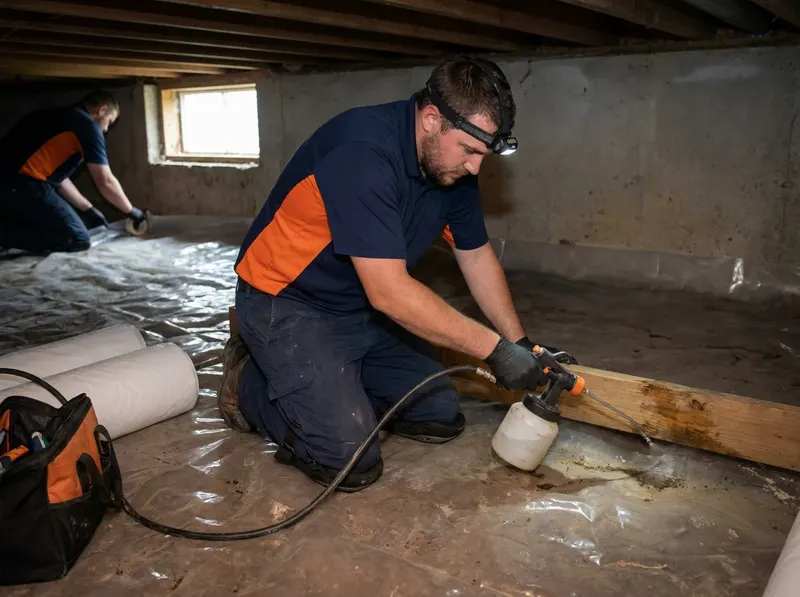
Crawlspace encapsulation and wood-boring beetle mitigation resolves chronic moisture loading and timber re-infestation in Sangamon County homes. Powderpost beetles (Lyctinae) and old house borers (Hylotrupes bajulus) require wood moisture contents exceeding 12% to sustain larval tunneling. Unsealed crawlspaces across Springfield neighborhoods like Enos Park, Vinegar Hill, and the Historic West Side pull heavy ground humidity into floor joists and subflooring via stack effect. Installing a reinforced 12-mil to 20-mil polyethylene vapor barrier across 100% of exposed earth cuts relative humidity below 50%, while direct chemical applications of disodium octaborate tetrahydrate penetrate 0.5 to 0.75 inches into dimensional lumber to eliminate active larvae.
Selecting standalone chemical treatment fits dry structural framing where wood moisture registers below 11% and the earthen floor already has intact ground sheeting. Full crawlspace encapsulation fits homes exhibiting active frass discharge, sagging joists, fungal bloom, or seasonal ground seepage near Lake Springfield and Carpenter Park Nature Preserve. Encapsulation requires mechanical dehumidification and closed foundation vents to maintain stable psychrometric conditions. The operational trade-off centers on upfront system installation cost versus ongoing framing replacement; sealing the space stabilizes load-bearing sills but eliminates passive outside airflow, making mechanical humidity extraction necessary.
Execution follows three precise technical stages: 1. Technicians measure joist moisture with pin-type resistance meters, scrape exit holes, and remove mold-fouled fiberglass insulation. 2. Dimensional framing receives liquid borate saturation applied at 20 to 40 PSI directly to raw wood surfaces, creating an insecticidal barrier that lasts decades. 3. Installers lay thick multi-ply vapor retarder across soil, mechanically fastening and taping seams to concrete stem walls with polyurethane adhesives. Properties in Leland Grove, Hawthorne, Twin Lakes, and Westchester with sandy-clay substrates require continuous perimeter drainage integration prior to final barrier placement to manage hydrostatic pressure.
Every job gets a firm, written price after a free on-site visit.
Tell us about your crawlspace encapsulation & wood-boring beetle mitigation job in Springfield and we'll send a clear, written quote, usually the same day.
 PestBoss Pros