Structural rodent exclusion operates differently from basic exterior toxicant baiting. Bait stations reduce localized mouse populations outside, but failing to physically seal exterior masonry gaps, roof returns, and…
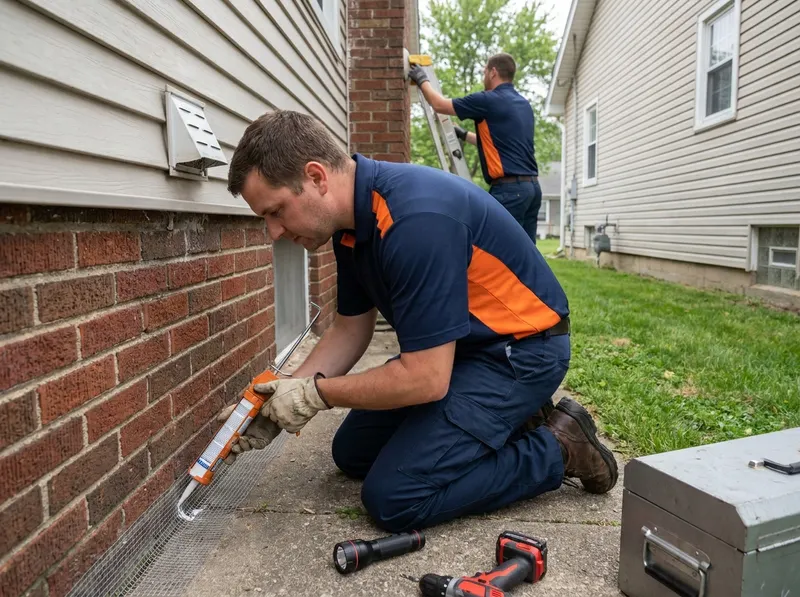
Structural rodent exclusion operates differently from basic exterior toxicant baiting. Bait stations reduce localized mouse populations outside, but failing to physically seal exterior masonry gaps, roof returns, and crawlspace vents leaves crawlspaces and attics vulnerable to continuous re-entry. In older architectural framing found in Enos Park, Vinegar Hill, and the Historic West Side, settlement cracks wider than 0.25 inches allow house mice (*Mus musculus*) and Norway rats (*Rattus norvegicus*) direct access behind drywall. Standard rodent exclusion stops infiltration at the perimeter by securing weep screeds, crawlspace doors, and rim joists with copper mesh, silicone elastomeric sealants, and galvanized hardware cloth.
Attic and crawlspace cleanouts address the biological hazards left behind after rodents chew electrical wiring jackets and soil horizontal surfaces. In neighborhoods like Leland Grove and Hawthorne, heavy oak canopy cover facilitates roof-level access where gray squirrels and rodents enter attic breezeways, compacting R-38 thermal insulation down to an ineffective R-12 while leaving urine-saturated pathways. Standard cleanout protocol involves negative-air containment, HEPA-filtered vacuum extraction of dry feces, removal of contaminated substrate down to structural joists, and applying an EPA-registered enzymatic mist to neutralize airborne hantavirus risk and persistent pheromone markers that draw subsequent colonies.
Decision criteria depend strictly on the age and physical state of the structure. For contemporary crawlspace and slab foundations in Westchester and Koke Mill East, isolated entry point sealing around AC line sets and garage door gaskets resolves the mechanical breach without requiring major substrate removal. Conversely, properties near rip-rap shorelines or water corridors around Lake Springfield or north toward Carpenter Park Nature Preserve experience higher burrow pressure along foundation perimeters; these sites require trenching 12 inches below grade to install hardware cloth footer curtains alongside interior structural sanitization.
Every job gets a firm, written price after a free on-site visit.
Tell us about your structural rodent exclusion & cleanout job in Springfield and we'll send a clear, written quote, usually the same day.
 PestBoss Pros