PestBoss ProsPestBoss Pros

Subterranean Termite Soil Treatment & Monitoring Springfield

Subterranean termite infestations in Sangamon County stem almost exclusively from *Reticulitermes flavipes*, a species that nests deep in subterranean moisture pockets and penetrates structures through expansion…
Get My Free Estimate →(217) 931-1196
Subterranean Termite Soil Treatment & Monitoring in Springfield, IL
Quick answer
  • What is included: Full perimeter soil trenching, rod injection, concrete drilling along slab attachments, continuous termiticide application, and tamper-resistant monitoring station installation every 10 to 15 linear feet.
  • Response time: On-site structural diagnostics occur within 24 to 48 hours across Sangamon County, with treatment execution completing in 1 to 2 days.
  • Estimated cost: Targeted perimeter treatments range from $850 to $1,800, full structural trench-and-drill programs cost $1,400 to $3,200, and annual station monitoring plans run $280 to $450; minimum service charge is $150.
  • Targeted wood-destroying organisms: Eastern subterranean termites (*Reticulitermes flavipes*), mud tubes, subterranean swarmer emergence, and secondary dampwood colonies.
  • How dispatch operates: Technicians schedule an on-site structural core assessment by calling (217) 931-1196 to verify foundation construction, soil density, and linear footage before generating a fixed quote.

Subterranean termite infestations in Sangamon County stem almost exclusively from *Reticulitermes flavipes*, a species that nests deep in subterranean moisture pockets and penetrates structures through expansion joints, plumbing penetrations, and hollow-block masonry. In Springfield neighborhoods with century-old architecture like the Historic West Side, Vinegar Hill, and Enos Park, stone and brick foundations often display active shelter tubes ascending basement walls toward sill plates and floor joists. Properties near wooded tracts and surface water, including Lake Springfield, Washington Park Botanical Garden, and Carpenter Park Nature Preserve, experience sustained underground colony pressure where clay-rich soils retain moisture and accelerate termite foraging activity. Liquid soil barrier treatments isolate the structure by excavating a 6-inch by 6-inch trench immediately adjacent to foundation walls, saturating the backfill with 4 gallons of termiticide per 10 linear feet per foot of depth, creating a zone that returning worker termites carry back to suppress the central nest.

Selecting between a liquid perimeter barrier and a dedicated bait monitoring array depends on foundation layout, soil permeability, and interior access limitations. Slab-on-grade homes in suburban developments such as Westchester, Koke Mill East, Hawthorne, and Leland Grove often conceal termite intrusion points beneath finished flooring, carpet tack strips, and mechanical chases. For uninterrupted slab-on-grade foundations, technicians drill 0.5-inch holes spaced 12 inches apart through exterior concrete slabs, patios, and garage aprons to reach the underlying soil directly, followed by flush hydraulic patching. The operational trade-off centers on intervention speed versus perimeter disruption: liquid barriers eliminate foraging pressure within 30 to 90 days but demand physical ground disruption, whereas non-invasive monitoring stations positioned at 10- to 15-foot intervals around the roof drip-line provide continuous colony baiting with zero concrete drilling, though full colony eradication through insect growth regulators requires 60 to 180 days.

Treatment execution follows three distinct technical protocols:

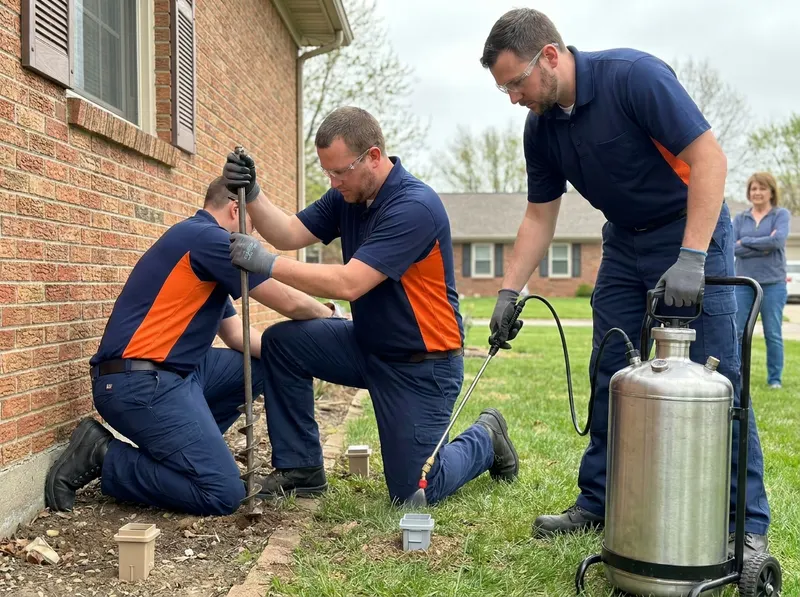
1. Exterior structural trenching: Technicians dig continuous trenches along exterior grade walls, rod-injecting liquid termiticide down to the top of the footing.

2. Sub-slab injection: Attached masonry, carports, and basement slabs are systematically core-drilled at 12-inch centers to inject termiticide directly into soil contact zones beneath the concrete.

3. Monitoring station installation and baseline reading: Low-profile, tamper-resistant monitoring stations containing cellulose attractants are countersunk into the turf every 10 to 15 linear feet, providing continuous monitoring points that alert technicians to sub-surface foraging before timber framing suffers compression or structural deflection.

Subterranean Termite Soil Treatment & Monitoring cost in Springfield

Baseline Diagnostic Assessment & Single-Point Spot Treatment$150, $350
Perimeter Liquid Soil Barrier Trenching (150, 200 Linear Feet)$850, $1,800
Comprehensive Slab Drilling & Deep Footing Barrier Program$1,400, $3,200
In-Ground Bait & Monitoring Station Array (Annual Servicing)$280, $450

Every job gets a firm, written price after a free on-site visit.

Common questions

How much does subterranean termite soil treatment cost in Springfield?
Perimeter soil treatments in Springfield typically cost between $850 and $3,200 depending on linear footage, slab drilling requirements, and foundation depth, with an absolute minimum single-visit charge of $150.
Are liquid termiticide soil treatments safe for pets and children around Springfield properties?
Liquid termiticides bind tightly to soil organic matter once injected below the grade or under slab concrete, eliminating airborne drift and surface residue risks to children and pets once backfilled trenches settle.
How often must termite monitoring stations be inspected across Sangamon County?
Subterranean termite bait stations installed across Springfield properties are checked quarterly or biannually to measure cellular consumption, assess moisture saturation, and deploy insect growth regulators upon initial strike.
Does homeowner insurance in Springfield cover subterranean termite damage repairs?
Standard homeowners insurance policies in Springfield exclude subterranean termite damage and eradication costs, classifying wood-destroying insect structural compromises as preventable property maintenance.
How long does a continuous liquid soil treatment barrier protect a Springfield home?
A continuous non-repellent liquid termiticide barrier installed according to labeled rates typically protects Springfield foundations against subterranean colony penetration for 5 to 10 years barring physical soil displacement.
Helpful resources

Trusted references & local links

USA.gov, government & consumer helpBetter Business BureauFTC Consumer AdviceU.S. Small Business AdministrationReady.govU.S. EPAENERGY STARU.S. Dept. of EnergyConsumer.govU.S. Census BureauGoogle Maps, Springfield, IL

Get started today

Tell us about your subterranean termite soil treatment & monitoring job in Springfield and we'll send a clear, written quote, usually the same day.

Get your free PEST CONTROL SEVICE quote, Springfield

We only use your ZIP to check availability, no spam.